Unit Converter Guide: Length & Weight Conversions Made Easy
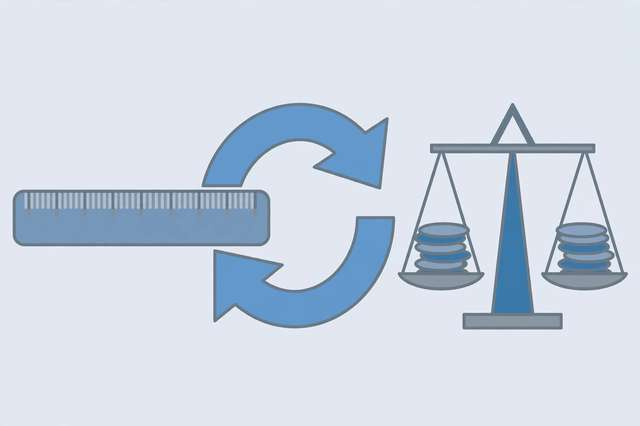
The recipe calls for 250 grams but your scale measures ounces. The shipping form wants kilograms but the box is labeled in pounds. The furniture listing gives dimensions in inches and you think in centimeters. Getting conversions wrong can mean a ruined cake, an overcharged shipment, or a sofa that doesn’t fit through the door.
This guide gives you the essential length and weight conversions in clear tables, mental-math shortcuts for quick estimates, and guidance on when “close enough” is fine versus when precision matters. For exact numbers, our free inches to centimeters converter handles inches↔cm instantly.
Metric vs imperial: the 60-second primer
The metric system (meters, grams, liters) is used by nearly every country in the world. It’s built on powers of ten: 1,000 millimeters in a meter, 1,000 grams in a kilogram. Conversions within metric are just moving a decimal point.
The imperial system (inches, feet, pounds, ounces) is still standard in the United States. Its units relate by irregular factors — 12 inches in a foot, 16 ounces in a pound — which is exactly why conversions feel harder.
You don’t need to memorize everything: a handful of anchor conversions and one reliable converter cover the rest.
Length conversions: the ones you’ll actually use
These five pairs cover the vast majority of everyday length conversions:
| Imperial | Metric | Exact factor | Quick mental trick |
|---|---|---|---|
| 1 inch | 2.54 cm | × 2.54 | Multiply by 2.5 |
| 1 foot | 30.48 cm | × 30.48 | Roughly 30 cm |
| 1 yard | 0.9144 m | × 0.9144 | Just under 1 meter |
| 1 mile | 1.609 km | × 1.609 | Multiply by 1.6 |
| 1 cm | 0.3937 in | ÷ 2.54 | A bit less than half an inch |
Inches ↔ centimeters
This is the single most-searched length conversion, and for good reason: product dimensions, screen sizes, clothing, and DIY measurements constantly cross the inch/cm boundary.
Examples:
- 10 inches × 2.54 = 25.4 cm
- 24 inches × 2.54 = 60.96 cm (a standard 24" monitor is about 61 cm wide)
- 100 cm ÷ 2.54 = 39.37 inches
Mental shortcut: multiply inches by 2.5 and add a touch. 10 inches ≈ 25 cm — close enough for shopping and rough planning.
Feet ↔ meters
Height, room dimensions, and sports fields live in feet↔meters territory.
Examples:
- 6 feet × 0.3048 = 1.83 m (a 6-foot person is 183 cm)
- 10 feet × 0.3048 = 3.05 m
- 2 meters ÷ 0.3048 = 6.56 feet
Mental shortcut: a foot is roughly 30 cm, so 6 feet ≈ 180 cm.
Miles ↔ kilometers
Road distances, running races, and fuel economy all need miles↔km.
Examples:
- 5 miles × 1.609 = 8.05 km (a 5-mile run is just over 8K)
- 26.2 miles × 1.609 = 42.16 km (marathon distance)
- 100 km ÷ 1.609 = 62.14 miles
Mental shortcut: the Fibonacci trick — 5 miles ≈ 8 km, 8 miles ≈ 13 km. Consecutive Fibonacci numbers approximate the mile/km ratio surprisingly well.
Weight conversions: pounds, kilos, ounces, grams
| Imperial | Metric | Exact factor | Quick mental trick |
|---|---|---|---|
| 1 pound (lb) | 0.4536 kg | × 0.4536 | Divide by 2.2 |
| 1 ounce (oz) | 28.35 g | × 28.35 | Roughly 28 g |
| 1 kg | 2.2046 lb | × 2.2046 | A bit over 2 lb |
| 1 stone | 6.350 kg | × 6.350 | UK body weight unit |
Pounds ↔ kilograms
Body weight, luggage limits, gym plates, and shipping weights all live here.
Examples:
- 150 lb ÷ 2.2046 = 68.0 kg
- 50 lb ÷ 2.2046 = 22.7 kg (a common checked-baggage limit)
- 80 kg × 2.2046 = 176.4 lb
Mental shortcut: divide pounds by 2 for a rough kilo figure, then add 10%. 150 lb → 75 → about 68 kg after the adjustment. Or simply remember: 1 kg ≈ 2.2 lb.
Ounces ↔ grams
Cooking is the main arena for ounces↔grams — American recipes in ounces and cups, the rest of the world in grams.
Examples:
- 8 oz × 28.35 = 226.8 g (8 fluid ounces of water)
- 4 oz × 28.35 = 113.4 g (one stick of butter)
- 500 g ÷ 28.35 = 17.6 oz
Mental shortcut: an ounce is just under 30 grams. Multiply ounces by 30 for a quick kitchen estimate — the error is under 6%.
How to convert mentally: handy factors worth memorizing
You only need five numbers for 90% of daily conversions:
- 2.5 — inches to cm (actual: 2.54)
- 0.3 — feet to meters (actual: 0.3048)
- 1.6 — miles to km (actual: 1.609)
- 2.2 — kg to pounds (actual: 2.2046)
- 28 — ounces to grams (actual: 28.35)
Round numbers make these even easier: 10 inches ≈ 25 cm, 10 feet ≈ 3 m, 10 miles ≈ 16 km, 10 kg ≈ 22 lb, 10 oz ≈ 280 g. Memorize the “tens” and scale up or down.
When precise conversion matters (and when it doesn’t)
Close enough is fine for: browsing furniture sizes, converting running distances, rough cooking, and travel planning.
Precision matters for:
- International shipping — customs declarations and postage are calculated on exact weight; rounding the wrong way costs real money.
- Baking and recipes — baking is chemistry. A 10% error in leavening or flour ratios can genuinely ruin the result; weigh ingredients when the recipe gives grams.
- Construction and DIY — “measure twice, cut once” exists because a quarter-inch error compounds across a project. Use exact conversions for cuts and fittings.
- Medication and health — dosing is weight-based; never estimate here.
- Engineering and manufacturing — tolerances are specified for a reason.
When precision matters, don’t do it in your head — use the inches to centimeters converter or a proper calculator and double-check the direction of the conversion (it’s embarrassingly easy to multiply when you should divide).
How to use an online unit converter: step by step
- Identify your starting unit and target unit. Inches → centimeters, pounds → kilograms, whatever you need.
- Enter the value in the converter’s input field.
- Select the units from the dropdowns if they’re not pre-set.
- Read the result — and sanity-check it. 10 inches should give about 25 cm, not 254 cm; if the answer looks off by a factor of 10 or 100, you’ve likely mixed up the direction.
- Round sensibly. For shopping, one decimal place is plenty. For construction, keep the precision the project needs.
Golden rule: sanity-check against a known anchor — a 6-foot person is about 183 cm, a liter of water weighs 1 kg. If your result contradicts an anchor, recheck your inputs.
Frequently asked questions
How do I convert inches to centimeters? Multiply inches by 2.54. So 10 inches = 25.4 cm. For quick mental math, multiply by 2.5 — the result is within 2% of exact.
How many kilograms is one pound? One pound equals 0.4536 kg. Divide pounds by 2.2 for a fast conversion: 150 lb ≈ 68 kg.
Why do the US and UK use different measurement systems? Most countries adopted metric in the 19th–20th centuries for its simple base-10 math. The US never completed the switch due to cost and inertia, so imperial persists alongside metric in daily American life.
When does precise unit conversion matter most? Precision is critical for shipping and customs, baking, construction measurements, medication dosing, and engineering. For browsing furniture sizes or converting running distances, a rough estimate is perfectly fine.
Keep reading

Alabama Income Tax 2026: Brackets, Rates, and Free Calculator
Alabama income tax for 2026: illustrative brackets and rates, deductions, credits, a calculation example, and a free calculator.
Read more →
Audio Converter Guide: MP3 vs WAV vs FLAC — Which Format Should You Use?
Confused by MP3 vs WAV vs FLAC? This guide explains lossy vs lossless audio formats, bitrates, when to use each, and how to convert audio free online.
Read more →
Book Schema Markup: Get Your Book into Google's Rich Results
Book schema markup helps your book appear in Google's rich results with cover, author, ratings, and price. Includes a JSON-LD example, key properties, and a free generator.
Read more →