Alabama Income Tax 2026: Brackets, Rates, and Free Calculator
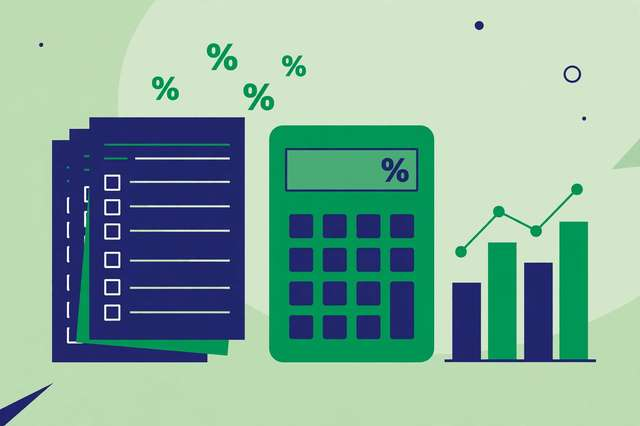
Alabama’s income tax has a quirk that catches newcomers off guard: it is one of the few states in the country with a genuinely progressive income tax, where bigger earners pay higher rates. It also comes with a rare perk — Alabama lets you deduct the federal income tax you paid from your state return, something only a handful of states allow. Because the brackets are narrow, many filers reach the top rate quickly, which makes do-it-yourself estimating tricky. This guide walks you through the illustrative 2026 brackets, how marginal rates work, the deductions and credits that matter most, a step-by-step hand calculation, and how to get an exact estimate in seconds with our free calculator.
How Alabama’s progressive income tax works
“Progressive” means your tax rate climbs as your income climbs. The key idea is marginal rates: a rate applies only to the income inside its bracket, not to your whole salary. If the top bracket is 5%, you do not pay 5% on everything — you pay 5% only on the slice of income above that bracket’s threshold, while lower slices are taxed at lower rates.
Two things make Alabama unusual. First, it is one of very few states that never adopted a flat income tax — your rate genuinely rises with income. Second, Alabama allows you to deduct the full amount of federal income tax you paid from your Alabama taxable income. That single deduction often saves Alabama filers more than any other line on the return.
Alabama income tax brackets for 2026 (illustrative)
Alabama’s brackets are narrow compared with most states, so a quick look at the table shows why the federal-tax deduction matters so much.
The brackets are small, so most working adults will have income spanning all three tiers. Remember: these are illustrative numbers that show how the math works, not official figures.
| Taxable income (single) | Illustrative rate |
|---|---|
| First $500 | 2% |
| $501 – $3,000 | 4% |
| Over $3,000 | 5% |
Married filers filing jointly get wider thresholds at each step — again, illustrative only. Notice how low the top-bracket threshold is: under this illustrative structure, anyone earning more than a few thousand dollars of taxable income pays the top rate on most of their earnings. That is exactly why the federal-tax deduction matters so much — it shrinks the taxable base before these rates ever touch it.
Deductions and credits: what lowers your Alabama bill
Before any bracket rate applies, you shrink your taxable income with deductions and exemptions:
- Federal income tax deduction. Deduct the full federal income tax you paid or accrued for the year. If you paid $6,000 in federal tax, that is $6,000 off your Alabama income right away.
- Standard deduction. Alabama offers a standard deduction that varies by income and filing status (illustrative: around $2,500 for single filers and $7,500 for joint filers). You can itemize instead if your itemized deductions are larger, but most filers take the standard amount.
- Personal exemptions. An illustrative personal exemption of about $1,500 per single filer ($3,000 joint), plus roughly $1,000 per dependent, directly reduces taxable income.
- Credits. Alabama offers targeted credits — for example, credits tied to dependents and certain business or education expenses — that reduce your final tax dollar-for-dollar. Credits beat deductions: a $500 credit cuts your tax by $500, while a $500 deduction only cuts it by your marginal rate times $500.
Keep records of federal tax payments, charitable giving, and dependent information — those are the documents that most commonly change a state return.
How to calculate your Alabama income tax by hand
Follow these steps with an illustrative example: a single filer with $60,000 of Alabama adjusted gross income who paid $8,000 in federal income tax.
Step 1: Start with Alabama adjusted gross income. Begin with the income figure Alabama uses — generally federal AGI adjusted for any Alabama-specific additions or subtractions. Our example starts at $60,000.
Step 2: Subtract the federal income tax deduction. $60,000 − $8,000 = $52,000. This is the step filers from other states would never think to take.
Step 3: Subtract the standard deduction and exemptions. Using the illustrative amounts: $52,000 − $2,500 (standard) − $1,500 (personal exemption) = $48,000 of taxable income.
Step 4: Apply the bracket rates to taxable income. Only the income inside each bracket gets that rate:
- First $500 at 2% = $10
- Next $2,500 at 4% = $100
- Remaining $45,000 at 5% = $2,250
Step 5: Add up the bracket taxes, then subtract credits. $10 + $100 + $2,250 = $2,360 estimated Alabama tax. If you qualified for a $300 dependent credit, the final bill would drop to $2,060.
That five-step pattern — income, minus federal tax, minus deductions and exemptions, apply brackets, minus credits — works for any Alabama return.
Get an instant estimate with the free calculator
Hand math is satisfying, but our Alabama income tax calculator runs the same five steps instantly — free, no sign-up, right in your browser.
Disclaimer: All bracket figures, deduction amounts, and example calculations in this article are illustrative examples only and may not match current law. Confirm exact rates and rules with the Alabama Department of Revenue or a qualified tax professional before filing.
Frequently asked questions
Does Alabama really have a progressive income tax?
Yes — Alabama is one of the few states with progressive brackets, so higher slices of income are taxed at higher rates. The brackets are narrow, which is why the federal-tax deduction matters so much.
How much can the federal tax deduction save me?
It depends on your federal bill, but since you deduct the full amount paid, it often cuts taxable income by thousands of dollars before any bracket rate applies.
Should I itemize or take the standard deduction in Alabama?
Take whichever is larger. Most filers benefit from the standard deduction unless they have large itemized expenses like mortgage interest or charitable gifts.
Are the numbers in this article the official 2026 figures?
No. They are illustrative examples showing how the calculation works. Verify current brackets and amounts with the Alabama Department of Revenue or a tax professional.
Keep reading
California Income Tax 2026: Brackets, Rates, and How to Calculate
California income tax brackets explained for 2026: illustrative rates, standard deduction basics, a marginal-rate example, and steps to estimate your tax.
Read more →
US States With No Income Tax in 2026
The 9 states with no income tax in 2026, what they charge instead in sales and property taxes, and a worked example of what moving really saves.
Read more →
Audio Converter Guide: MP3 vs WAV vs FLAC — Which Format Should You Use?
Confused by MP3 vs WAV vs FLAC? This guide explains lossy vs lossless audio formats, bitrates, when to use each, and how to convert audio free online.
Read more →