US States With No Income Tax in 2026
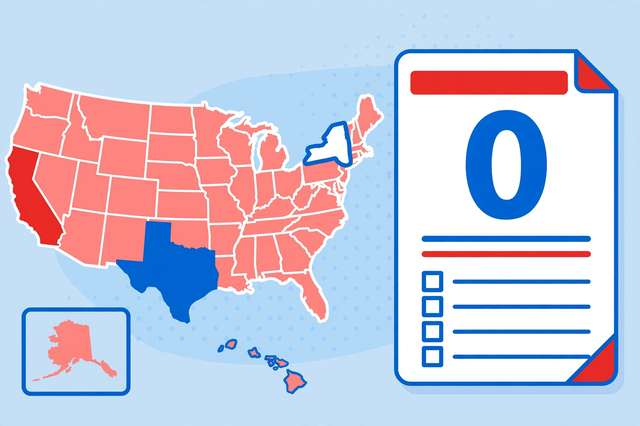
Where you live can change your tax bill by thousands of dollars a year — and nine US states make the difference as large as it gets by charging no tax on wage income at all. If you work remotely, are planning a move, or are simply comparing job offers across state lines, knowing exactly which states have no income tax (and what they charge instead) is real money. This guide lists the nine states for 2026, explains the two “almost” states people confuse them with, and shows how to compare the total tax picture before you pack a single box.
The 9 states with no income tax in 2026
As of the 2026 tax year, nine states levy no broad-based tax on wages and salaries:
- Alaska — no state income tax and no state sales tax (some localities charge one).
- Florida — no income tax; funded heavily by sales tax and tourism.
- Nevada — no income tax; gaming and sales taxes carry the load.
- New Hampshire — completed its phase-out: the tax on interest and dividends was fully repealed from January 1, 2025, so wages and investment income are now untaxed at state level.
- South Dakota — no income tax, a long-standing low-tax outlier in the Midwest.
- Tennessee — its Hall tax on interest and dividends ended in 2021; wages were never taxed.
- Texas — no income tax (barred by the state constitution), famously offset by high property taxes.
- Washington — no tax on wages, but it does levy a 7% capital gains tax on high earners (gains above a large annual threshold), which courts have upheld as an excise tax.
- Wyoming — no income tax and low overall tax burden, with energy revenue doing much of the work.
Saving this list is easy; using it well takes one more step — because “no income tax” never means “no taxes.”
The taxes that replace the income tax
States need revenue, and the nine above collect it elsewhere. Property taxes are the classic trade: Texas and New Hampshire rank among the highest property-tax states in the country, routinely taking 1.6% to 2% of a home’s value every year — on a $400,000 home, that can quietly return much of the income-tax saving to the state. Sales taxes run higher in Tennessee (9.55% average combined rate, the nation’s highest) and Washington, which hits everyday spending instead of paychecks. Fees, excise taxes, and insurance costs fill the remaining gaps — Florida’s homeowners insurance market, for instance, is among the most expensive in the US.
The honest comparison is household-specific: your income, whether you rent or own, home value, and spending patterns decide which state is actually cheaper for you. A high-earning renter usually wins big in Texas or Florida. A moderate-income homeowner in a pricey Texas suburb may find a low-income-tax state with cheap property taxes — like Colorado or Utah — costs less overall. When you estimate the federal side of any scenario, our federal income tax estimator keeps the IRS part constant so the state difference stands out clearly.
Two states that almost qualify
New Hampshire earned its place on the list only recently — for decades it taxed interest and dividends at 5%, then 3%, before repealing the tax entirely from 2025. Retirees should still note the history: older guides listing New Hampshire as “taxes investment income” are simply out of date.
A different confusion surrounds states like Oregon (no sales tax, but some of the highest income taxes) and Delaware (no sales tax, moderate income tax). “No tax” headlines almost always refer to one tax type. Meanwhile, states such as North Carolina and Arizona have been cutting income-tax rates toward low flat levels — not zero, but small enough that the total-burden comparison gets interesting. And Washington’s capital gains tax is a reminder to read your own situation: a founder selling a business there faces a real state tax bill despite the “no income tax” label.
What moving actually saves: a quick example
Take a remote worker earning $110,000, currently in a state with a roughly 5% effective income tax — about $5,500 a year to the state. Moving to Florida or Texas erases that line. If they rent, the saving is nearly pure. If they buy a $420,000 home in Texas at a 1.8% property-tax rate versus 0.9% in their old state, the extra property tax is about $3,800 a year — the move still wins by roughly $1,700 annually, but not by the headline $5,500. Run your own version of this math with real numbers from your target city: property-tax rate on the homes you would actually buy, sales-tax rate on your spending, and insurance quotes. An afternoon of arithmetic beats a year of surprises.
Before you move for taxes
A few cautions from people who have done this badly. Residency is sticky: your old state may tax you until you genuinely establish domicile elsewhere — driver’s license, voter registration, primary home, and days spent all matter, and high-tax states audit departures of high earners. Remote-work rules cut both ways: some states (famously New York) tax remote workers whose employer is based there even after they move. Non-tax costs dominate: housing prices, insurance, schools, and proximity to family routinely outweigh a few points of tax. Treat the tax saving as one strong factor in a bigger decision, and estimate the full move cost with the same care — then the nine states on this list become what they should be: a genuine financial advantage for the people whose lives fit them.
Frequently asked questions
The FAQ below covers Social Security taxation, whether these states tax retirement income, and how the list is expected to change — the three questions readers ask most after seeing the nine names.
Keep reading
7 Free Finance Apps Every American Should Try
The 7 best free finance apps for Americans in 2026: budgeting, saving, investing and credit monitoring — all with genuinely useful free tiers.
Read more →Best Free Credit Score Apps in the US & UK (2026)
Compare the best free credit score apps in the US and UK for 2026. Which bureaus they cover, what's actually free, and how to use them.
Read more →
Credit Utilization Explained and How Much of Your Limit to Use
Credit utilization explained: the under-10% zone, why one maxed card hurts, and the statement-date trick that improves your score in one cycle.
Read more →