How to Save for a House Down Payment Fast (Even on an Average Salary)
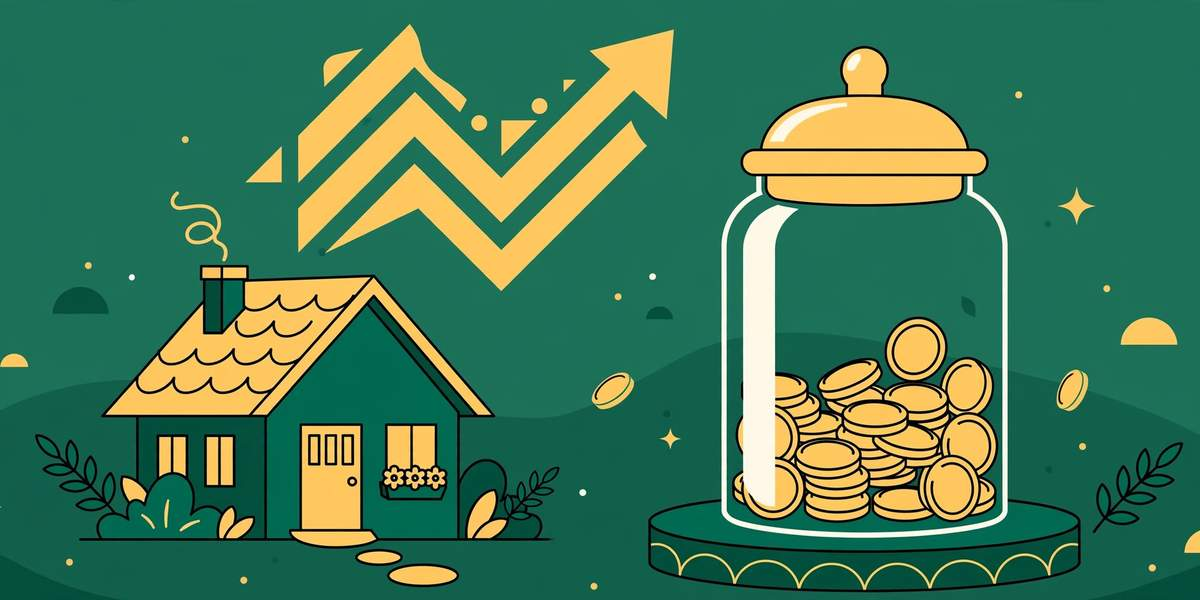
A house down payment is the biggest savings target most people ever face. Five figures, minimum — staring at you from a spreadsheet while rent keeps rising. No wonder so many people assume it’s impossible on an average salary.
It’s not impossible. It’s just a math problem wearing a scary costume. Break it into a target, a timeline, and a monthly number — then build a system that hits that number automatically. Here’s how.
Step 1: Know your real number
You can’t hit a target you haven’t defined. “Save for a house” is a wish; “$28,000 by June 2028” is a plan.
The down payment math
Pick a realistic home price for your area — not your dream home, your first home. Then apply a deposit percentage:
- 3–5%: possible with first-time buyer loan programs in the US and similar schemes elsewhere, but expect mortgage insurance costs.
- 10%: a common middle ground — lower monthly costs than minimum-deposit loans without the long wait for 20%.
- 20%: avoids mortgage insurance entirely and gets the best rates, but takes the longest.
Example: on a $300,000 home, 5% is $15,000, 10% is $30,000, and 20% is $60,000. Write down your number. Seeing it concretely is motivating, not scary — vague goals are what feel impossible.
Don’t forget closing costs
The down payment isn’t the whole bill. Budget an extra 2–5% of the purchase price for closing costs: lender fees, inspections, appraisals, insurance, and moving expenses. On that $300,000 home, that’s another $6,000–$15,000. Add it to your target now so it doesn’t ambush you later.
Step 2: Park it in the right place
Where you keep the money matters almost as much as how fast you save it.
- A separate high-yield savings account is the right home for down payment savings. Separate, so you never “borrow” from it; high-yield, so it earns something while it waits.
- Not the stock market. Your timeline is short and your target is fixed. A 20% market dip the year you plan to buy would be devastating — and entirely avoidable.
- Not your checking account. Money that sits next to your spending money gets spent. Separation is a feature, not an inconvenience.
Name the account something specific like “House Deposit.” Named accounts get raided far less often than generic savings.
Step 3: The speed-up playbook
Now the engine room. You don’t need all seven levers — pick the three or four that fit your life.
1. Automate the transfer first
On payday, an automatic transfer moves your deposit savings out of checking before you can spend it. Start with whatever you can — even a modest amount — and increase it every few months. Automation beats willpower every single time.
2. Attack the big three expenses
Housing, transport, and food swallow most budgets. One big win here beats fifty small ones:
- Housing: a cheaper rental, a roommate, or moving back with family temporarily can free up hundreds monthly — the single fastest accelerator for most savers.
- Transport: refinancing a car loan, dropping to one car, or switching commute modes.
- Food: meal planning and cutting delivery apps routinely saves households $200–$400 a month.
3. Bank every windfall
Tax refunds, bonuses, cash gifts, side-hustle payouts — decide now that 50–100% of every windfall goes straight to the deposit fund. Windfalls feel like free money, which makes them the easiest money to save.
4. Add one income stream
You don’t need a second job forever — just during the saving sprint. Freelancing a skill you already have, weekend gig work, or selling unused belongings can add several hundred a month. Earmark 100% of it for the deposit.
5. Run a temporary spending freeze
A one-month no-spend challenge (we have a full guide) can jump-start the fund and reveal subscriptions and habits worth cutting permanently. Many savers find $300–$600 hiding in one paused month.
6. Track the number monthly
Update a simple tracker on the first of each month: target, saved so far, remaining, months left. Watching the “remaining” column shrink is the motivation that carries you through year two of saving.
7. Check for first-time buyer help
Many countries and states offer first-time buyer programs: lower deposit requirements, grants, or matched savings schemes. These programs change often and have eligibility rules, so research what’s currently available where you live — it could shave thousands off your target.
What a realistic timeline looks like
Let’s make it concrete. Target: $30,000 (10% on a $300,000 home, before closing costs):
- Saving $500/month → 60 months (5 years)
- Saving $800/month → ~38 months (just over 3 years)
- Saving $1,000/month → 30 months (2.5 years)
- Saving $1,250/month → 24 months (2 years)
Notice the jump from $500 to $1,000 cuts the timeline in half. That’s why the big-three expenses and extra income matter more than skipping lattes — they move the monthly number by hundreds, not tens.
Add your closing-costs buffer on top, and be honest about the timeline. A realistic 3-year plan you follow beats a fantasy 18-month plan you abandon.
5 mistakes that slow you down
- Saving without a target date. “Someday” savings get raided. A date makes it real.
- Keeping the money in checking. If you can see it next to your spending money, you’ll spend it.
- Investing the deposit. The stock market is for long timelines. Your deposit timeline isn’t one.
- Lifestyle-creeping every raise. Each pay rise should increase the automatic transfer, not the spending.
- Waiting to start until it’s “the right time.” The right time is the month you automate the first transfer — even a small one. Compounding habit beats perfect timing.
Frequently asked questions
Q: How much do I actually need for a down payment?
A: It ranges from around 3% to 20% of the home price depending on the loan type, and first-time buyer programs in many countries allow lower deposits. Whatever the percentage, budget an extra few percent for closing costs, which are separate from the down payment itself.
Q: Where should I keep my down payment savings?
A: In a separate high-yield savings account — not invested in stocks. Your timeline is short and the goal amount is fixed, so you cannot afford a market dip right before you buy. Keep it safe, separate, and earning a modest return.
Q: Is it worth waiting until I have 20% to avoid mortgage insurance?
A: Not always. Mortgage insurance costs something each month, but waiting years to reach 20% means years of rent paid and potential price rises. Run both scenarios with your numbers — for many first-time buyers, buying sooner with a smaller deposit wins.
Q: Should I pause retirement contributions to save for a down payment faster?
A: Generally, keep contributing at least enough to capture any employer match — that is free money you cannot get back later. Beyond the match, some people temporarily redirect extra retirement savings toward the deposit. This is a regulated decision, so consider speaking with a licensed financial adviser.
Keep reading
Sinking Funds: The Complete Step-by-Step Setup Guide
Sinking funds turn big irregular bills into small monthly savings. This step-by-step setup guide covers categories, amounts, and tracking tips.
Read more →
The No-Spend Challenge: A 30-Day Guide That Actually Works
Thinking of trying a no-spend month? Here's the complete guide: the rules, what's allowed, a prep checklist, and how to survive all 30 days.
Read more →
Lifestyle Creep: The Silent Budget Killer (and How to Beat It)
Got a raise but still broke? That's lifestyle creep. Learn the 7 warning signs and the exact system that keeps your raises in your pocket — not your landlord's.
Read more →