How to Check Text Similarity Online Free (Plagiarism Basics)
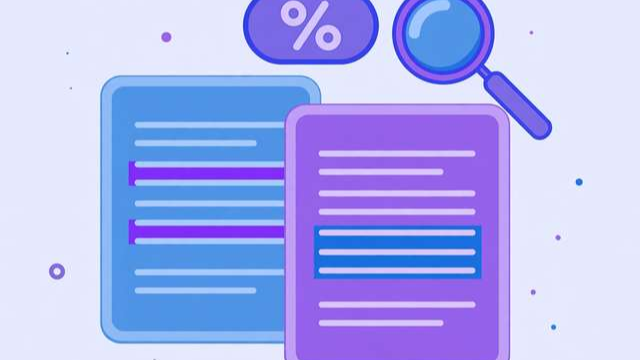
Few things are more stressful than submitting an essay, article, or product page and later discovering it reads too much like someone else’s words. Plagiarism does not have to be deliberate copying — it can come from heavy paraphrasing of a single source or absorbing phrasing from something you read. A free text similarity checker is the simplest way to catch these problems before anyone else does.
Checking text similarity online takes less than a minute. You paste in two texts, the tool compares them, and you get a percentage plus highlighted passages showing exactly where they overlap. This guide explains what similarity scores actually mean, how to check text similarity for free, and how to fix problem passages — the plagiarism basics every writer, student, and freelancer should know.
What “text similarity” actually means
Text similarity is a measurement of how much two pieces of writing overlap, expressed as a percentage. A score of 0 percent means the texts share no meaningful phrases; 100 percent means they are identical. The calculation looks at matching sequences of words and characters, not just overall topic — two articles about the same subject can score low if each is written in the writer’s own words.
Similarity is not the same as plagiarism. A quote with proper attribution will raise your similarity score, but it is not plagiarism. A bibliography will raise it too, since reference lists match thousands of other documents. Common phrases like “in conclusion” or “as a result” add tiny amounts of overlap that no checker can judge as right or wrong. Similarity is a measurement; plagiarism is a judgment about how that overlapping text is used.
That distinction matters: a high similarity number is not a conviction — it is a prompt to check the highlighted passages.
How similarity checkers work
Most free similarity checkers use a straightforward comparison technique. First, they break each text into overlapping chunks of words, typically three to five words long. Then they count how many chunks appear in both texts. Finally, they convert that count into a percentage of the total text. Matching passages are highlighted so you can see exactly where the overlap sits.
Free browser-based checkers compare only the texts you provide. That makes them perfect for specific jobs: comparing your draft against a source article, checking whether two writers produced suspiciously similar work, or verifying that your rewrite is genuinely different from the original. They cannot search the web for you — for that, you need a database-backed service.
How to check text similarity online for free
Here is the exact workflow using our free text similarity checker:
- Prepare your two texts. One should be your draft or the text under review; the other is the source you want to compare against — a reference article, a classmate’s submission, or an earlier version of your own work.
- Paste both into the tool. Our checker runs entirely in your browser, so your text is never uploaded or stored.
- Run the comparison. The tool breaks both texts into word sequences and calculates the overlap percentage in a fraction of a second.
- Read the score, then read the highlights. The percentage is only the headline. Scroll through the highlighted matching passages to see which sentences are identical, which are close paraphrases, and which are just common phrases.
- Fix, then re-check. Rewrite the problem passages in your own words, paste the revised text back in, and confirm the score dropped.
The whole process takes a few minutes and costs nothing, which means there is no excuse for skipping it before submitting anything important.
Reading your similarity score: what the percentage really means
Use these rough bands as a starting point for self-checking:
- Under 10 percent: normal. Quotes, terminology, and common phrases account for this much overlap in most original writing.
- 10–20 percent: typical for work with quoted passages or technical vocabulary. Check the highlights, but there is usually nothing to fix.
- 20–30 percent: investigate. Some passages are probably too close to the source. Rework the longest matches.
- Over 30 percent: rewrite. At this level, large chunks of your text mirror the source. Paraphrase properly or add original analysis.
Context changes everything: a literature review full of cited quotes will legitimately score higher than a personal essay, and code or legal boilerplate inflates scores without any wrongdoing. Always judge the highlighted passages, not just the number.
How to fix high similarity before it becomes plagiarism
When the highlights point at real problems, here is how to fix them properly:
- Rewrite from understanding, not from the source. Read the passage, close it, and explain the idea in your own words without looking. This produces genuinely different phrasing instead of surface-level word swaps.
- Change the structure, not just the words. Rearrange the order of ideas, combine sentences, or split long sentences into shorter ones. Similarity algorithms key on word sequences, so structural changes drop scores fast.
- Add your own voice and examples. Original analysis, examples, and opinions are automatically unique. A paragraph that explains what a fact means to your argument is far safer than one that just restates the fact.
- Quote and cite properly. If a passage is worth keeping verbatim — a definition, a striking statistic, a well-known phrase — put it in quotation marks and credit the source. Quoted text still counts toward similarity, but it is not plagiarism. After rewriting, run the comparison again. Aim for a score where the only highlights left are short phrases and properly attributed quotes.
Common mistakes people make with similarity scores
- Chasing 0 percent. A zero score is unnecessary — common phrases, terminology, and quotes always add a few percent. Aim for low, not zero.
- Trusting the number alone. Two texts can score 15 percent and still contain one fully copied paragraph, or score 35 percent from nothing but a long bibliography. Always review the highlights.
- Ignoring formatting differences. Extra spaces, line breaks, and punctuation differences can slightly shift scores between tools. Do not compare a score from one checker against a threshold published by another.
- Assuming a low score means safe. Free checkers compare the two texts you provide. They cannot tell you whether your text matches something on the internet — that requires a database-backed plagiarism service.
Frequently asked questions
What is a text similarity checker?
A text similarity checker compares two pieces of text and calculates how much they overlap, usually as a percentage. It is the simplest form of plagiarism screening — useful for comparing a draft against a source, or two documents against each other.
How do I check text similarity for free?
Paste the two texts into a free similarity checker tool, click compare, and review the percentage plus the highlighted matching passages. Our free text similarity checker runs entirely in your browser, so nothing is uploaded or stored.
What is a good similarity score?
For original work, aim for the lowest score you can realistically get. Under 10 percent is generally fine for most purposes; quotes, references, and common phrases push scores up naturally. Anything above 25–30 percent deserves a close look at the highlighted passages.
Is text similarity the same as plagiarism detection?
No. Similarity only measures overlap — it cannot tell whether text was properly quoted, cited, or paraphrased. Plagiarism detection adds database comparison and academic judgment on top. Think of similarity as the raw measurement, not the verdict.
Keep reading
How to Combine Keywords Into Long-Tail Lists in Seconds (Free Tool)
Turn a handful of seed keywords into a long-tail keyword list in seconds. Learn the combining method, power modifiers, and how to clean the list.
Read more →
How to Compress a PDF to 500KB Online Free
Shrink any PDF down to 500KB for uploads and applications. Why PDFs get bloated, what survives compression, and a free in-browser tool.
Read more →
How to Convert PDF to TXT Online Free
Turn any PDF into clean plain text in seconds. What survives conversion, how to handle scanned PDFs, and a free in-browser converter.
Read more →